
Frontier AI companies probably can't leave the US
The executive branch can, and probably would, block a frontier AI company's departure.

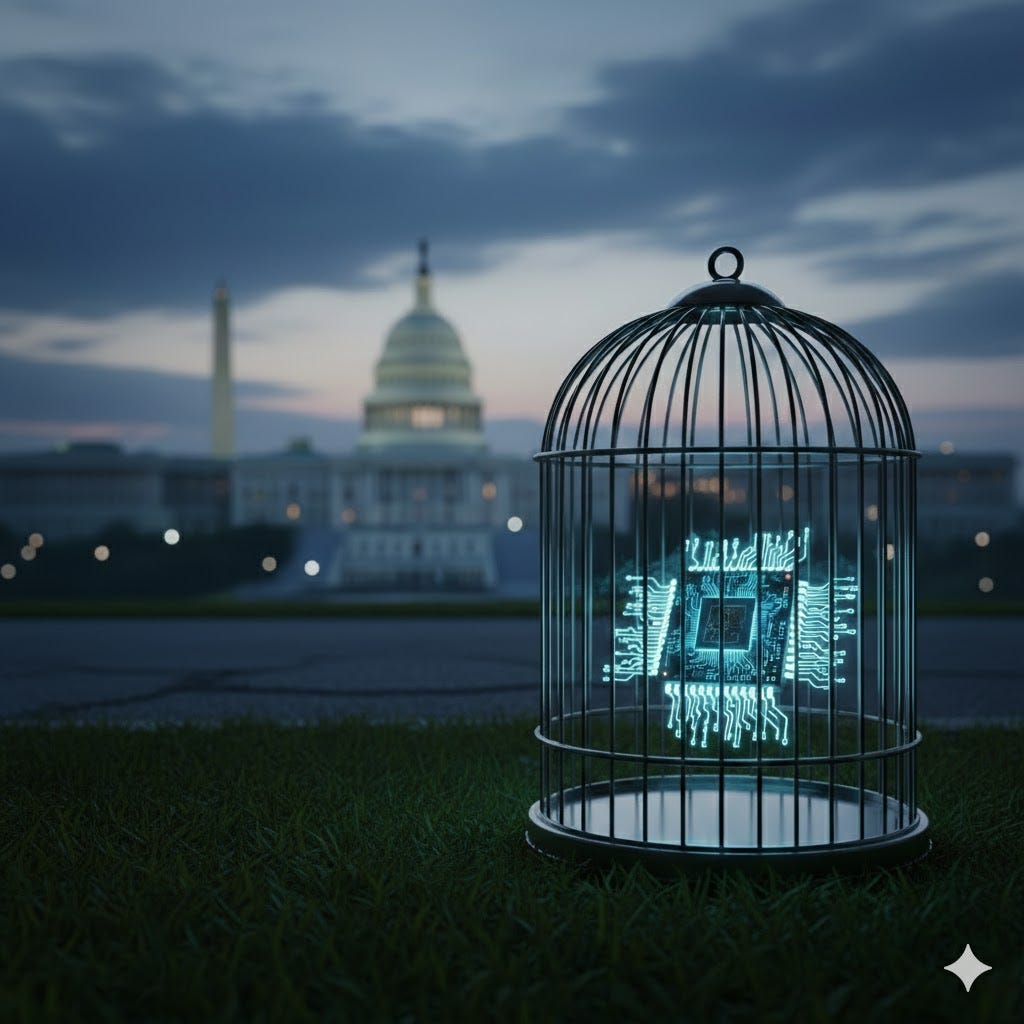
It’s plausible that, over the next few years, US-based frontier AI companies will become very unhappy with the domestic political situation. This could happen as a result of democratic backsliding, weaponization of government power (along the lines of Anthropic’s recent dispute with the Department of War), or because of restrictive federal regulations (perhaps including those motivated by concern about catastrophic risk). These companies might want to relocate out of the US.
However, it would be very easy for the US executive branch to prevent such a relocation, and it likely would. In particular, the executive branch can use existing export controls to prevent companies from moving large numbers of chips, and other legislation to block the financial transactions required for offshoring. Even with the current level of executive attention on AI, it’s likely that this relocation would be blocked, and the attention paid to AI will probably increase over time.
So it seems overall that AI companies are unlikely to be able to leave the country, even if they’d strongly prefer to. This further means that AI companies will be unable to use relocation as a bargaining chip, which they’ve attempted before to prevent regulation.
Thanks to Alexa Pan, Arun Jose, Buck Shlegeris, Jake Mendel, Josh You, Ryan Greenblatt, Stefan Torges, and Tim Hua for comments on previous drafts.
Frontier companies leaving would be huge news
I think that a move by a frontier company would be shocking. It would, at least for a few weeks, receive massive amounts of international and domestic coverage (plausibly more than all of AI gets now in a typical week). Front pages would cover the political turmoil caused by it, commentators would speculate about motivations, and politicians would lose sleep. The OpenAI board drama, for example, massively spiked coverage of the company.
It would be as if Lockheed Martin announced one day that it was moving to Canada. Anthropic faced threats of being cut off from all defense contracts merely for disputing usage terms with the Pentagon; the reaction to a full departure would be much more severe.
The move would signal, at least to political leadership, a critical loss of confidence in America, and threaten the US’s global leadership in tech. It might be read by the American public equally negatively. Such a big move might trigger a cascade event, with investors and companies leaving en masse. At least the government would fear it could.
I picture the move massively expanding the Overton window for AI policies, and prompting immediate decisive action from the executive. To appease public outcry and alarmed national security officials, the US president would be pushed to take drastic measures to prevent the exit of the company.
It would be easy for the US government to prevent AI companies from leaving
Preventing this exit is likely to be very easy for the US executive using existing authorities.
The scenario I’m envisioning involves a company moving abroad to remove US government leverage over them. Relying on US cloud providers, for example, would still give the government the ability to enforce restrictions. In order to become fully independent, companies would have to move their chips, employees, money, and IP.
The president can block chip exports and transactions
The president has broad authority to control exports via executive order.
First, AI chips fall under the Export Administration Regulations (EAR), over which the president has direct control. This grants the president the authority to modify items under export control at will. There is also substantial legal precedent to support export restriction in the case of mass-export of chips by a US-based company: EAR powers have previously been used to restrict exports of products to Huawei. Although the departure of a US company might not involve the sale of assets, physically relocating controlled items out of the United States constitutes an export under EAR, and preventing it would be in the president’s authority.
Second, the president could invoke the International Emergency Economic Powers Act (IEEPA) to freeze any asset or block any transaction in which a foreign country or national has an interest under the condition that there be an “unusual and extraordinary threat” from abroad. This last clause has been interpreted broadly, and would likely encompass threats related to frontier AI capabilities falling outside US control.1 Importantly, the act applies even if a frontier company could leave the US without moving chips or datacenters, because such a move would almost definitely require some transactions with foreign entities. The government could block the movement of corporate funds, physical assets, and intellectual property (like model weights). This authority has been used to restrict US investment in chips abroad.
Importantly, changing export controls and invoking the IEEPA do not require approval from Congress, in contrast with expropriation or nationalization. Both laws would make it a crime to attempt such exports, violations of which could lead to prison time.
Ultimately, the impact of export controls depends on the company’s reliance on US-based chips, which I argue will be high in Companies can’t leave without their US-based assets. In any case, the asset freezes under the IEEPA would likely be crippling.
Companies can’t get their US assets out against the government’s will
It would likely be impossible for a company to leave the US secretively. A large-scale move of personnel would require coordination of hundreds if not thousands of staff, and large-scale transfers of physical and financial capital, which would generate massive media coverage and so is basically certain to be noticed by the government.
Despite the prevalence of chip smuggling in general, this would be nearly impossible for a frontier company.
Chip smuggling is often performed in batches of a few thousand whereas a frontier company would need to move millions of chips.
Major frontier companies are already subject to a great deal of government scrutiny, and carefully track their chips.
Chip smuggling is also becoming increasingly difficult. The AI Action Plan specifies plans to implement location verification on AI chips, and NVIDIA has built the requisite technology.
Political will to prevent smuggling is strong, which has led to a number of new bills seeking to improve enforcement.
Since chips in use are concentrated in datacenters, government monitoring and securing would be particularly easy.
Furthermore, all US companies would be subject to any restrictions, so large cloud providers, banks, shipping companies, or advisors that assist in the relocation would also face legal ramifications. Any company that illegally moves would have to move large amounts of data, chips, and assets essentially alone, making it easy to detect and almost impossible.
Companies can’t leave without their US-based assets
A company could decide on the desperate strategy of “cut losses and escape”. After all, the measures I’ve identified probably don’t prevent individuals leaving with their private money. However, I think such a strategy would cost the company its competitive position unless it is already extremely far ahead of all other companies.
Chip restrictions would likely be a major barrier to relocation because a significant proportion of compute used by frontier companies is likely in the US, as Microsoft, Amazon, and Google, the primary sources of datacenters, have almost all of their AI datacenters in the US. The US government is likely to aim to keep it that way; other countries like Saudi Arabia may build additional datacenters, but ensuring US-based compute remains necessary for companies to stay at the frontier aligns with existing policy goals.2
Even if a company heavily invested in datacenters abroad (or in space), the chip supply chain would remain a bottleneck. The EAR would make it difficult to replace existing chips or buy new ones, because the government could pressure chip manufacturers to cut off the company by threatening the manufacturers’ access to US-origin equipment and software. A relocating company would essentially need to find a completely new supply chain, a task that is prohibitively difficult.
Even if chips could be moved, any company that leaves the US would also take a significant financial hit, losing access to US-based bank accounts, US investors, and US banks. Notably, any international bank that wishes to do business in the US (essentially every major global bank) would be off-limits for such a company. This would make day-to-day financing, like paying employees’ salaries, extremely difficult.
Finally, companies would lose massive amounts of progress if they abandon IP in the US. But moving the IP would be illegal, likely detectable (a highly capable model appearing without extensive training runs would be highly suspicious) and grounds for arresting leadership involved with the move. The expertise memorized by individuals is probably insufficient to compete with other US-based companies.
These costs would likely be sufficient to prevent companies attempting a move.
Current political will is likely sufficient to prevent the departure of a frontier company
I expect a large majority of relevant actors, like the office of the president, national security officials, congress, and the public, to support measures to prevent the departure of a frontier company.
The White House, in the July 2025 AI Action Plan, described maintaining AI dominance as a “national security imperative”. This view is bipartisan; the Biden administration released a document in support of the CHIPS act claiming it is “essential that [the US does] not offshore this critical technology”. As the salience of AI rises in national security circles, it is likely the perceived importance of protecting the US’s AI lead would also increase. Since the departure of a frontier company would destroy this lead, blocking it would probably be popular among officials. Congress is also supportive of protectionist policy on AI, and has passed restrictions on foreign sales of chips with bipartisan support. A majority of the public is supportive of measures to prevent the export of powerful AI models; this support would probably carry over to preventing the departure of frontier companies.
The White House is invested in maintaining long-term dominance in chip production, as demonstrated by the purchase of a 10% share in Intel. The US has also pushed for US-based datacenters, by removing permitting requirements and, in one case, requiring reciprocal investment from a partner. The Biden administration was even more restrictive, implementing a (now rescinded) rule requiring companies to keep at least half their compute in the US. These policies suggest sufficient will to discourage companies from gradually moving compute outside US jurisdiction.
The current administration has been more lenient about chip exports, but that latitude is unlikely to extend to a frontier company relocating. The cases are meaningfully different:
Chip exports have US-based beneficiaries (NVIDIA, AMD, and other companies in the chip industry) whose profits, jobs, and tax revenue remain domestic. Allowing a frontier company to leave would mean ceding some profit to another jurisdiction for little economic benefit.
Lenient chip exports can be justified on the grounds of increasing diffusion and global reliance on US companies. Allowing a major company to move its headquarters overseas has no analogous justification.
Chip access can be restricted if AI becomes more strategically important, but it is difficult to force a company to return to the US once it has already left.
Moves to allied nations are also likely to be prevented. Sanctions against AI companies could be relatively targeted to minimize diplomatic fallout, by only prosecuting company leadership and denying access to particular US-based services (like cloud providers). This may cause tension with close allies, but the US already has a precedent of restricting security-relevant businesses transacting overseas even with allies. Given the deployment of AI in the US military, frontier AI would likely receive the same treatment. Even allied governments may use frontier AI in ways that conflict with US interests, and a company’s departure would reduce US leverage over the ally. The US has historically shown a willingness to disregard or pressure allies and businesses to achieve political aims:
The US pressured international banks to disclose the holdings of US persons.
The US threatened allies to make them enforce chip export restrictions against China.
The US used secondary sanctions to force EU compliance with sanctions against Iran.
Overall, I think political will is sufficient that were a US-based company to attempt relocation tomorrow, it would face significant policy challenges if not outright prohibition. This is doubly true given the uproar I expect to accompany such a move, as I illustrate above.
Implications
We should expect major US-based AI companies to remain in the US for the foreseeable future. Even more gradual strategies for leaving the US (like gradually moving employees and datacenters) would likely result in substantial backlash from the government, and disentanglement from institutions subject to US law (like banks, cloud providers, etc.) would still be very difficult.
Importantly, it is significantly easier to prevent AI companies from leaving than to nationalize them. Existing precedent dictates that a president cannot seize private property without the consent of congress, and the sections of the Defense Production Act which would allow such expropriation have expired. Although certain types of soft nationalization (e.g., mandatory government oversight) may be more likely, stronger control over leading companies may still be politically and legally difficult. So, we may expect export controls to effectively stop AI developers from leaving the US some time before nationalization (if either of these happen).
The recent ruling against Trump’s tariffs is significantly different because they were taxes rather than absolute restrictions.
I have not found good estimates of the geographical distribution of compute used by every frontier company, but this seems true of planned datacenters.